How to Crack IIT JEE Without Coaching: Complete Self-Study Guide
Preparing for the IIT Joint Entrance Examination (JEE) is a dream for millions of students across India. Every year, lakhs of aspirants compete for admission to prestigious Indian Institutes of Technology (IITs), but only a small percentage secure a seat. While many students join expensive coaching institutes, one question continues to inspire thousands of aspirants:
Can you crack IIT JEE without coaching?
The answer is yes.
Many successful IITians have proved that self-study, discipline, consistency, and the right strategy can outperform expensive coaching programs. Coaching can provide guidance, but it does not guarantee success. Your dedication, conceptual understanding, problem-solving skills, and regular practice ultimately determine your rank.
If you are motivated, willing to follow a structured study plan, and ready to work consistently, you can certainly crack JEE Main and even JEE Advanced without joining a coaching institute.
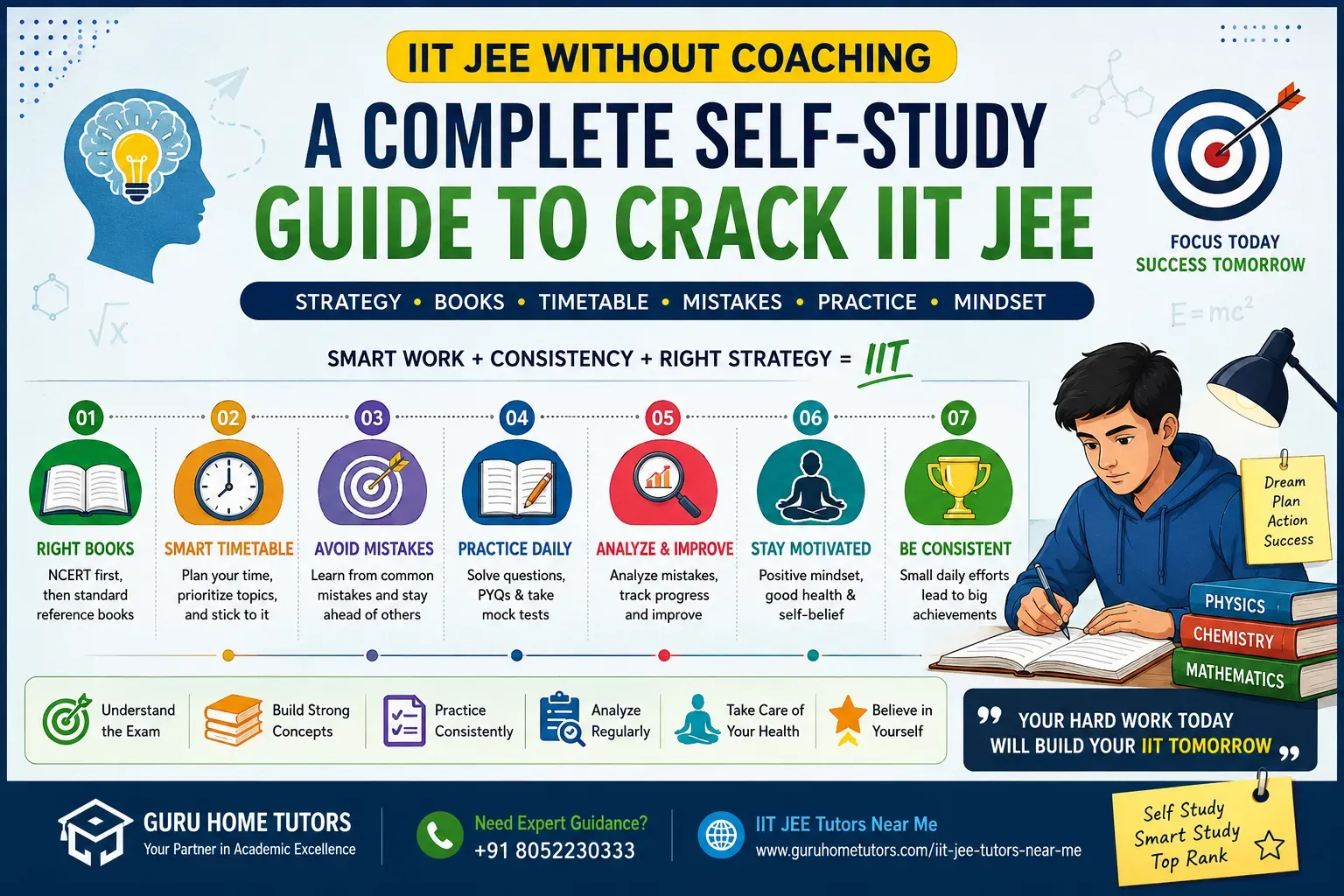
This comprehensive guide explains everything you need to know—from creating the perfect study schedule to choosing the best books, avoiding common mistakes, solving previous years' papers, and maintaining motivation throughout your preparation.
Why Thousands of Students Prepare Without Coaching
Not every student has access to top coaching institutes. Some live in small towns or villages, while others cannot afford coaching fees that often range from ₹1 lakh to ₹3 lakh per year.
Fortunately, the education landscape has changed dramatically.
Today, students have access to:
-
Free YouTube lectures
-
NCERT books
-
Previous years' JEE papers
-
Online mock tests
-
Digital notes
-
AI-powered learning tools
-
Doubt-solving platforms
-
Expert home tutors
-
Online one-to-one mentoring
With these resources, self-study has become more practical than ever before.
The biggest advantage of self-study is that students learn at their own pace instead of following a fixed classroom schedule.
Can You Really Crack IIT JEE Without Coaching?
Yes—but only if you prepare smartly.
Many students believe coaching is compulsory because a large number of toppers come from famous institutes. However, coaching itself is not the reason for success.
Successful students generally possess these qualities:
-
Strong fundamentals
-
Daily study discipline
-
Regular revision
-
Consistent problem-solving practice
-
Mock test analysis
-
Positive mindset
-
Time management
-
Patience and persistence
Even the best coaching institute cannot help students who lack consistency.
On the other hand, a disciplined student with proper guidance can achieve an excellent rank through self-study.
Why Self-Study Can Be Better Than Coaching
Many students perform better when studying independently because they can focus on their own weaknesses.
Some major advantages include:
1. Learn at Your Own Speed
Every student learns differently.
Some understand Physics quickly but struggle with Chemistry.
Others find Mathematics difficult but enjoy Organic Chemistry.
Self-study allows you to spend extra time where it's needed instead of following a fixed classroom pace.
2. Flexible Study Schedule
Without coaching, you can create a timetable that matches your productivity.
For example:
-
Morning: Physics
-
Afternoon: Chemistry
-
Evening: Mathematics
-
Night: Revision
You have complete control over your preparation.
3. Better Focus
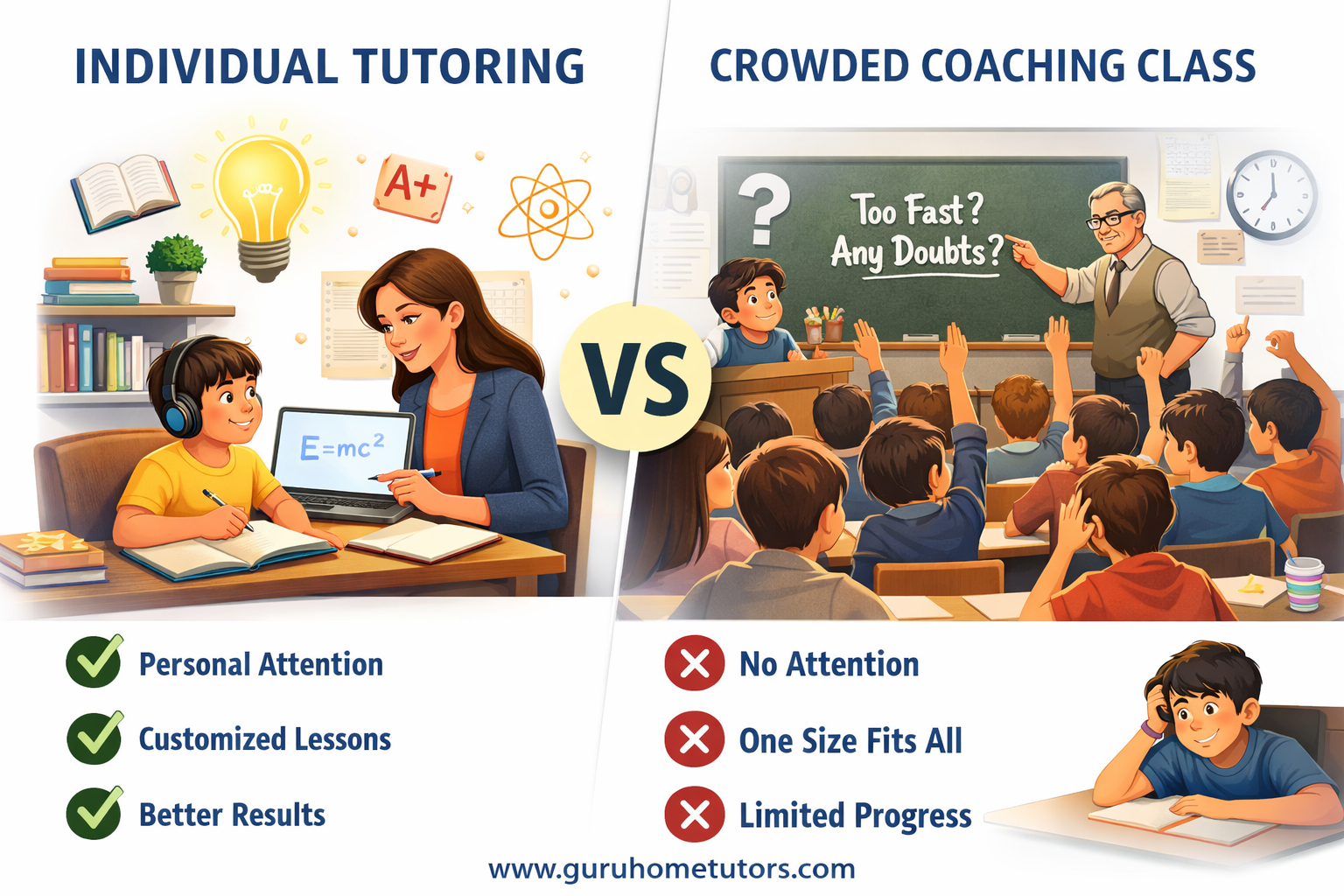
Large coaching batches often contain hundreds of students.
During self-study:
-
Fewer distractions
-
Personalized learning
-
More revision time
-
Better concentration
-
Greater flexibility
Quality study is always more important than the number of classroom hours.
4. Saves Time
Many coaching students spend several hours travelling every day.
Self-study saves valuable time that can be invested in:
-
Revision
-
Mock tests
-
Doubt solving
-
Exercise
-
Proper sleep
Is Coaching Completely Unnecessary?
Not necessarily.
Some students require additional guidance for difficult topics.
If you struggle with advanced Mathematics, Physics, or Chemistry concepts, taking help from an experienced mentor can significantly improve your preparation.
Instead of joining expensive full-time coaching, many students now prefer one-to-one home tuition or online mentoring for difficult subjects.
Experienced mentors help students:
-
Understand difficult concepts
-
Avoid common mistakes
-
Stay motivated
-
Improve problem-solving speed
-
Prepare strategically for JEE Main and Advanced
If you're looking for experienced one-to-one mentors, explore Guru Home Tutors' IIT JEE Tutors:
https://www.guruhometutors.com/iit-jee-tutors-near-me
You can learn from experienced IIT JEE faculty while continuing your self-study, giving you the best of both worlds.
Success Stories That Inspire Millions
Every year, numerous students qualify for IITs without enrolling in expensive coaching institutes.
Their stories reveal several common habits:
-
They mastered NCERT before advanced books.
-
They solved thousands of practice questions.
-
They revised regularly.
-
They analysed every mock test.
-
They focused on conceptual understanding instead of memorisation.
-
They remained consistent for two years.
Their success proves that hard work combined with smart planning always beats shortcuts.
What You Will Learn in This Complete Guide
In the next sections of this guide, you'll discover:
-
The exact IIT JEE syllabus and exam pattern
-
JEE Main vs JEE Advanced differences
-
Best books for self-study
-
A complete two-year preparation roadmap
-
Daily and weekly study schedules
-
Time management strategies
-
Common mistakes to avoid
-
Mock test techniques
-
Revision plans
-
Free online resources
-
Motivation tips for long-term preparation
-
Frequently Asked Questions
Whether you are studying in Class 11, Class 12, or taking a drop year, this guide will help you prepare efficiently without depending entirely on coaching institutes.
Final Thoughts
Cracking IIT JEE without coaching is not about studying harder than everyone else—it is about studying smarter, staying consistent, and believing in your preparation. Thousands of students have achieved this goal through disciplined self-study, and with the right strategy, you can too.
In the next part, we'll understand the JEE Main and JEE Advanced exam pattern, eligibility, syllabus, and the mistakes students make before they even begin preparing. This foundation is essential because a clear understanding of the exam helps you plan your preparation more effectively.
Understanding IIT JEE: JEE Main vs JEE Advanced (Complete Exam Guide)
Before starting your preparation, it is essential to understand what IIT JEE actually is. Surprisingly, many students spend months studying without fully understanding the exam pattern, eligibility criteria, syllabus, and the difference between JEE Main and JEE Advanced. This often leads to poor planning and unnecessary stress.
One of the smartest things you can do before opening your books is to understand the examination thoroughly. A well-informed student can prepare more strategically than someone who studies blindly.
What is IIT JEE?
The Joint Entrance Examination (JEE) is India's most prestigious engineering entrance examination. It is conducted in two stages:
- JEE Main
- JEE Advanced
Students first appear for JEE Main. Those who qualify with a high enough percentile become eligible to appear for JEE Advanced, which is the gateway to admission into the Indian Institutes of Technology (IITs).
Apart from IITs, JEE Main scores are also accepted by:
- National Institutes of Technology (NITs)
- Indian Institutes of Information Technology (IIITs)
- Government Funded Technical Institutes (GFTIs)
- Several reputed private engineering colleges
Therefore, performing well in JEE Main itself opens the door to many excellent engineering colleges across India.
JEE Main vs JEE Advanced
Many beginners assume both examinations are the same. In reality, they differ significantly in terms of difficulty, competition, and question style.
| Feature | JEE Main | JEE Advanced |
|---|---|---|
| Purpose | Admission to NITs, IIITs & eligibility for Advanced | Admission to IITs |
| Difficulty Level | Moderate to High | Very High |
| Conducting Authority | National Testing Agency (NTA) | One of the IITs on a rotational basis |
| Question Style | Conceptual + Numerical | Highly analytical and application-based |
| Eligibility | Class 12 or equivalent | Qualified candidates of JEE Main |
Understanding this difference helps students prepare according to the actual expectations of each examination.
IIT JEE Exam Pattern
The syllabus primarily covers Class 11 and Class 12 Physics, Chemistry, and Mathematics.
Physics
Physics tests conceptual understanding along with numerical problem-solving skills.
Important areas include:
- Mechanics
- Laws of Motion
- Work, Energy & Power
- Rotational Motion
- Thermodynamics
- Oscillations & Waves
- Electrostatics
- Current Electricity
- Magnetism
- Optics
- Modern Physics
Instead of memorising formulas, students should focus on understanding concepts and their practical applications.
Chemistry
Chemistry is generally divided into three sections:
Physical Chemistry
Requires conceptual clarity and numerical practice.
Organic Chemistry
Focuses on reaction mechanisms and conceptual understanding rather than rote memorisation.
Inorganic Chemistry
NCERT plays a crucial role. Regular revision is essential because factual information can easily be forgotten.
Mathematics
Mathematics is often considered the most challenging section because it demands speed, accuracy, and extensive practice.
Major topics include:
- Algebra
- Quadratic Equations
- Complex Numbers
- Coordinate Geometry
- Trigonometry
- Calculus
- Probability
- Vectors
- Three-Dimensional Geometry
- Matrices & Determinants
Daily practice is the key to mastering Mathematics.
How Much Time is Required to Crack IIT JEE?
This is one of the most searched questions online.
The answer depends on your current academic level.
If you are in Class 11
You have approximately two years, which is considered the ideal preparation period.
Students can comfortably build concepts while maintaining school studies.
If you are in Class 12
You still have sufficient time.
The focus should be on:
- Completing the remaining syllabus
- Strengthening Class 11 concepts
- Solving previous years' questions
- Taking regular mock tests
If You Are a Dropper
Many successful IITians secured excellent ranks during their drop year.
A drop year can be highly productive if students:
- Analyse previous mistakes
- Follow a disciplined routine
- Avoid unnecessary distractions
- Practise consistently
Success depends on the quality of preparation rather than the number of attempts.
Common Mistakes Students Make Before Preparation
Many aspirants unknowingly make mistakes that slow down their progress.
Some of the most common ones include:
Starting Advanced Books Too Early
Students often purchase multiple reference books without first mastering NCERT.
Strong fundamentals are far more important than collecting books.
Ignoring NCERT
Especially in Chemistry, NCERT remains one of the most valuable resources.
Many direct and indirect questions are based on NCERT concepts.
Following Too Many Teachers
Switching repeatedly between YouTube channels, coaching notes, and different teaching methods creates confusion.
Choose one reliable source for each subject and stay consistent.
Avoiding Mock Tests
Many students postpone mock tests until the syllabus is complete.
This is a major mistake.
Mock tests help identify weak areas much earlier, allowing sufficient time for improvement.
Studying Without Revision
Learning new topics every day without revising previous chapters leads to poor retention.
Revision should be an integral part of your daily schedule.
Should You Study Alone or Seek Guidance?
Self-study is highly effective, but seeking guidance whenever required can save valuable time.
If you struggle with difficult topics like Calculus, Organic Chemistry, or Modern Physics, learning from an experienced mentor can significantly improve conceptual clarity.
Many students now combine self-study with personalized one-to-one mentoring, which offers flexibility without the high cost of traditional coaching institutes.
If you need expert guidance for difficult subjects, you can explore experienced IIT JEE mentors at:
https://www.guruhometutors.com/iit-jee-tutors-near-me
Personalized mentoring helps students overcome doubts quickly while continuing their independent preparation.
Self-Assessment: Are You Ready for IIT JEE?
Ask yourself these questions:
- Do I genuinely enjoy solving challenging problems?
- Am I willing to study consistently for 2–3 years?
- Can I maintain discipline without external pressure?
- Am I prepared to learn from mistakes?
- Can I stay motivated even after scoring poorly in mock tests?
If your answer is yes to most of these questions, you already possess one of the most important qualities required for IIT JEE success.
Best Books for IIT JEE Self-Study & Complete Resource Guide
One of the biggest mistakes IIT JEE aspirants make is buying too many books. Every year, students spend thousands of rupees on study materials, believing that having more books automatically leads to a better rank. In reality, most toppers use only a few carefully selected resources and revise them multiple times.
If your goal is to crack IIT JEE without coaching, remember this golden rule:
One excellent book revised five times is far more valuable than five books studied only once.
The secret is not collecting resources—it is mastering them.
Is NCERT Enough for IIT JEE?
This is one of the most frequently asked questions.
The answer is partly yes and partly no.
Physics
NCERT builds basic concepts but is not sufficient for the advanced level of JEE Main and JEE Advanced. You will need additional problem-solving practice.
Chemistry
For Inorganic Chemistry, NCERT is the most important book. Many questions are directly or indirectly based on NCERT concepts.
For Organic Chemistry, NCERT provides a foundation, but conceptual understanding and reaction practice are equally important.
For Physical Chemistry, you need extensive numerical practice beyond NCERT.
Mathematics
NCERT helps strengthen fundamentals, but it is not enough for JEE-level preparation. Advanced questions require higher-level practice and conceptual application.
Conclusion: Never skip NCERT. Master it first, then move to advanced books.
Best Books for Physics
Physics requires conceptual clarity along with numerical problem-solving ability.
Build Your Foundation
- NCERT Physics (Class 11 & 12)
These books should be your starting point.
Problem-Solving Practice
After completing NCERT, solve one high-quality reference book consistently.
Focus on:
- Mechanics
- Electricity
- Magnetism
- Modern Physics
- Optics
- Thermodynamics
Instead of solving random questions from multiple books, complete one book thoroughly before moving on.
Best Books for Chemistry
Chemistry is often considered the highest-scoring subject because many concepts become easier with regular revision.
Physical Chemistry
Focus on:
- Formula understanding
- Numerical practice
- Concept application
Daily practice improves speed significantly.
Organic Chemistry
This section requires:
- Reaction mechanisms
- Named reactions
- Conceptual understanding
- Continuous revision
Avoid memorizing reactions without understanding why they occur.
Inorganic Chemistry
Students often ignore this section, but it can become a major scoring area.
Read NCERT repeatedly.
Revise:
- Periodic Table
- Chemical Bonding
- Coordination Compounds
- p-Block Elements
- d & f Block Elements
Short notes work exceptionally well for Inorganic Chemistry.
Best Books for Mathematics
Mathematics rewards students who practise consistently.
Important topics include:
- Algebra
- Calculus
- Coordinate Geometry
- Trigonometry
- Probability
- Vectors
- 3D Geometry
Instead of attempting difficult problems immediately, solve:
- Basic Questions
- Moderate Questions
- Advanced Problems
This gradual approach builds confidence and accuracy.
How Many Books Should You Use?
Many students ask:
"Should I solve three or four books for every subject?"
The answer is No.
A simple strategy works much better.
For each subject:
- NCERT
- One good reference book
- Previous Years' Questions
- Mock Tests
That's enough for most serious aspirants.
The real challenge is revision—not collecting books.
Best Free Online Resources
Students preparing without coaching have access to excellent free learning resources.
Use them wisely.
Helpful resources include:
- Official NTA practice papers
- Previous Years' Question Papers
- Free mock tests
- Educational YouTube lectures
- Digital flashcards
- AI-powered doubt-solving tools
However, avoid watching videos endlessly.
Remember:
Watching lectures is learning.
Solving questions is preparation.
Your success depends more on practice than video consumption.
Previous Years' Question Papers Are Gold
One of the biggest advantages self-study students have is access to thousands of previous years' questions.
Benefits include:
- Understanding question patterns
- Identifying important chapters
- Improving speed
- Increasing confidence
- Learning time management
Many concepts repeat with different numerical values or applications.
Solve previous years' papers multiple times.
Make Your Own Notes
Never underestimate handwritten notes.
Instead of copying entire chapters, prepare concise revision notes containing:
- Important formulas
- Short tricks
- Difficult concepts
- Frequently forgotten facts
- Reaction mechanisms
- Mistakes made during mock tests
During the final revision, these notes become extremely valuable.
Build a Digital Formula Notebook
Along with handwritten notes, maintain a digital notebook where you store:
- Formula sheets
- Important diagrams
- Difficult numerical questions
- Frequently asked concepts
Review these every weekend.
Small, regular revisions prevent information overload before the examination.
When Should You Seek Expert Guidance?
Although self-study is highly effective, some students struggle with advanced concepts such as:
- Calculus
- Organic Chemistry
- Electromagnetism
- Rotational Mechanics
- Coordinate Geometry
Instead of remaining stuck for weeks, seek help from an experienced mentor.
A good teacher can explain difficult concepts within minutes that might otherwise take days to understand.
Students looking for personalized one-to-one mentoring can explore experienced faculty through Guru Home Tutors:
👉 IIT JEE Tutors Near Me
https://www.guruhometutors.com/iit-jee-tutors-near-me
Expert mentors provide structured guidance while allowing students to continue independent preparation.
Avoid These Common Resource Mistakes
Many aspirants unknowingly waste valuable preparation time.
Avoid:
- Buying every recommended book.
- Switching between multiple teachers.
- Collecting endless PDFs without reading them.
- Watching lectures without practising questions.
- Ignoring NCERT.
- Studying only favourite subjects.
- Skipping previous years' papers.
- Making overly lengthy notes.
A focused study plan always beats an overloaded bookshelf.
Key Takeaways
If you remember only five things from this section, let them be:
- Master NCERT before moving to advanced resources.
- Use one reliable reference book per subject.
- Solve previous years' papers regularly.
- Prepare short revision notes.
- Practise more than you watch.
These habits create a strong foundation for consistent progress.
Complete IIT JEE Self-Study Timetable: Daily, Weekly & Monthly Study Plan
One of the biggest reasons students fail to crack IIT JEE is not because they lack intelligence, but because they lack consistency. Many aspirants study for 10–12 hours one day and then hardly study the next two days. This irregular approach leads to poor retention, frustration, and burnout.
If you want to crack IIT JEE without coaching, your goal should not be to study the maximum number of hours. Instead, focus on studying effectively every single day.
Remember this simple formula:
Consistency beats intensity.
A student who studies 6 focused hours daily for two years often performs better than someone who studies 14 hours occasionally.
How Many Hours Should You Study Every Day?
There is no universal answer because every student's situation is different.
If You Are in Class 11
- School: 6–7 hours
- Self-study: 4–6 focused hours
- Revision: 1 hour daily
Focus on building strong concepts instead of rushing through the syllabus.
If You Are in Class 12
Since board examinations and JEE preparation run together, time management becomes extremely important.
Recommended self-study:
- 5–7 focused hours daily
- Weekly revision
- Previous years' questions
- Mock tests
If You Are a Dropper
Droppers usually have more available study time.
A balanced schedule may include:
- 7–9 productive study hours
- Short breaks
- Daily revision
- Mock tests
- Physical exercise
- Proper sleep
Quality always matters more than quantity.
Ideal Daily Study Schedule
Here is a practical timetable that many successful students follow.
| Time | Activity |
|---|---|
| 5:30–6:00 AM | Wake up & light exercise |
| 6:00–8:00 AM | Mathematics Practice |
| 8:00–9:00 AM | Breakfast & Break |
| 9:00–11:00 AM | Physics Concepts |
| 11:00–11:30 AM | Short Break |
| 11:30–1:00 PM | Chemistry |
| 1:00–2:00 PM | Lunch & Rest |
| 2:00–4:00 PM | Question Solving |
| 4:00–5:00 PM | Exercise / Walk |
| 5:00–7:00 PM | Weak Subject Practice |
| 7:00–8:00 PM | Dinner |
| 8:00–9:30 PM | Revision |
| 9:30–10:00 PM | Formula Review & Planning |
| 10:30 PM | Sleep |
You don't have to copy this exactly. Modify it according to your school timings and personal routine.
The 50-10 Study Rule
Many toppers follow a simple productivity technique:
- Study for 50 minutes
- Take a 10-minute break
During the break:
- Drink water
- Stretch your body
- Walk for a few minutes
- Avoid social media
This improves concentration and reduces mental fatigue.
Weekly Study Strategy
Your week should include a balance of learning, practice, and revision.
Monday to Friday
- Learn new concepts
- Solve practice questions
- Revise previous chapters
Saturday
- Solve mixed-topic question sets
- Work on weak chapters
- Update short notes
Sunday
- Take a full-length mock test
- Analyse mistakes
- Revise formulas
- Plan the next week
Many students skip mock tests because they fear low scores. This is a mistake. Every mock test is an opportunity to identify weaknesses before the actual exam.
Monthly Preparation Goals
Instead of thinking only about the final examination, divide your preparation into monthly targets.
Each month should include:
- Completion of selected chapters
- Revision of previous topics
- One or two full mock tests
- Error analysis
- Formula revision
- Previous years' questions
Breaking preparation into smaller goals makes it easier to stay motivated.
The Power of Revision
Students often spend all their time learning new topics but forget to revise old ones.
A simple revision strategy is:
Daily Revision
30–45 minutes
Weekly Revision
Revise everything studied during the week.
Monthly Revision
Review all important formulas, concepts, and mistakes.
Without revision, even well-understood concepts fade over time.
Balance All Three Subjects
Many students spend excessive time on their favourite subject while ignoring weaker ones.
For example:
- Strong in Mathematics
- Weak in Chemistry
Instead of solving Mathematics all day, allocate additional time to Chemistry until it improves.
A balanced score across all three subjects usually leads to a better overall rank.
Use Mock Tests Wisely
Mock tests are not just for checking marks.
They help you:
- Improve speed
- Increase accuracy
- Develop exam temperament
- Learn time management
- Identify weak chapters
After every mock test, spend time analysing:
- Which questions were easy but answered incorrectly?
- Which chapters need more revision?
- Where did you waste time?
- Which silly mistakes can be avoided?
This analysis is often more valuable than the mock test itself.
Take Care of Your Health
Many students believe sleeping less will improve productivity.
The opposite is true.
Maintain:
- 7–8 hours of quality sleep
- Healthy meals
- Regular exercise
- Adequate water intake
- Limited screen time
A healthy mind learns faster and retains information longer.
When Should You Take Help?
If you remain stuck on the same topic despite repeated efforts, don't waste weeks trying to solve it alone.
Seek guidance from:
- A school teacher
- A trusted mentor
- An experienced IIT JEE faculty member
- A one-to-one online or home tutor
Getting timely help saves time and prevents frustration.
Students looking for personalized mentoring can explore experienced faculty here:
👉 IIT JEE Tutors Near Me
https://www.guruhometutors.com/iit-jee-tutors-near-me
A good mentor doesn't replace self-study—they make your self-study more efficient.
Build Discipline, Not Motivation
Motivation comes and goes.
Discipline stays.
Successful IIT aspirants study:
- Even when they don't feel motivated.
- Even after poor mock test scores.
- Even when chapters become difficult.
Small daily improvements eventually lead to remarkable results.
Quick Daily Checklist
Before ending your day, ask yourself:
- ✅ Did I complete today's target?
- ✅ Did I revise yesterday's topics?
- ✅ Did I solve enough questions?
- ✅ Did I learn something new?
- ✅ Did I make short notes?
- ✅ Did I avoid unnecessary distractions?
- ✅ Did I sleep on time?
If the answer is "yes" most days, you are already moving in the right direction.
Common Mistakes IIT JEE Aspirants Make (And How to Avoid Them)
Preparing for IIT JEE without coaching is absolutely possible, but it requires more than intelligence and hard work. Every year, thousands of talented students fail to achieve their desired rank—not because they lack potential, but because they repeat the same avoidable mistakes.
The good news is that learning from others' mistakes is much easier than learning from your own. If you can identify these pitfalls early and build the right habits, you'll save valuable time, reduce stress, and significantly improve your chances of success.
Mistake #1: Studying for Long Hours Without Productivity
Many students proudly claim they study 12–14 hours a day, but after a few weeks, they realize they remember very little.
Remember:
Quality of study is more important than quantity of study.
Studying with complete focus for 5–6 productive hours is far more effective than sitting with books for 12 distracted hours.
Improve Productivity By:
- Turning off mobile notifications.
- Studying in distraction-free environments.
- Setting daily targets.
- Taking short breaks after every study session.
- Avoiding multitasking.
Mistake #2: Ignoring NCERT
Some students directly begin solving advanced books because they believe NCERT is "too easy."
This is one of the biggest preparation mistakes.
Especially in Chemistry, NCERT remains one of the most important resources for both JEE Main and board examinations.
A strong foundation makes advanced concepts much easier.
Mistake #3: Watching Too Many YouTube Lectures
Free online lectures are excellent resources—but only when used wisely.
Many students spend hours watching lectures every day but solve very few questions.
Learning happens in two stages:
- Understanding concepts.
- Applying concepts.
Without sufficient practice, even the best lectures won't improve your rank.
A useful rule is:
- Learn a concept.
- Immediately solve related questions.
- Revise after a few days.
Mistake #4: Solving Easy Questions Only
Students naturally enjoy solving questions they already know.
Unfortunately, growth happens when you attempt challenging problems.
Every week, include:
- Easy questions
- Moderate questions
- Difficult questions
Don't fear mistakes.
Every wrong answer teaches something valuable.
Mistake #5: Comparing Yourself with Others
This is especially common among coaching and online study groups.
Students constantly compare:
- Study hours
- Mock test scores
- Completed chapters
- Book collections
Comparison creates unnecessary stress.
Instead, compare yourself with your previous performance.
Ask:
- Am I improving?
- Am I making fewer mistakes?
- Am I solving questions faster than last month?
Personal improvement matters far more than temporary comparisons.
Mistake #6: Ignoring Weak Subjects
Many students spend excessive time studying subjects they enjoy.
For example:
- Mathematics: 4 hours
- Physics: 3 hours
- Chemistry: 30 minutes
Eventually, Chemistry becomes the reason for losing rank.
Your weakest subject deserves the highest priority.
Improving a weak subject usually increases your overall score more than perfecting your strongest one.
Mistake #7: Not Revising Regularly
One of the biggest reasons students forget concepts is the lack of revision.
Use the following strategy:
Daily Revision
Revise important formulas and concepts before sleeping.
Weekly Revision
Spend one day revising everything studied during the week.
Monthly Revision
Review complete chapters using short notes and previous mistakes.
Revision converts short-term memory into long-term understanding.
Mistake #8: Avoiding Mock Tests
Some students delay mock tests until they complete the syllabus.
This is a mistake.
Mock tests help you:
- Improve speed.
- Build confidence.
- Learn time management.
- Identify weak chapters.
- Reduce examination fear.
Even if your initial scores are low, don't be discouraged.
Every mock test is an opportunity to improve.
Mistake #9: Not Analysing Mistakes
Taking mock tests alone isn't enough.
The real improvement comes from analysis.
After every test, ask yourself:
- Why did I answer this incorrectly?
- Was it a conceptual mistake?
- Was it calculation error?
- Did I read the question incorrectly?
- Was I under time pressure?
Maintain an Error Notebook.
Write down:
- Difficult questions.
- Silly mistakes.
- Frequently forgotten formulas.
- Weak concepts.
Review this notebook regularly.
Mistake #10: Poor Time Management
Many students spend too much time on one difficult question.
During the examination:
- Solve easy questions first.
- Skip lengthy problems initially.
- Return later if time permits.
Smart students maximize their scores by managing time wisely.
Time Management Tips from Successful Aspirants
A disciplined routine often produces better results than last-minute hard work.
Some practical tips include:
- Plan tomorrow's study schedule before sleeping.
- Keep daily targets realistic.
- Divide large chapters into smaller sections.
- Use timers while solving questions.
- Avoid unnecessary social media usage.
- Track weekly progress instead of daily mood.
Consistency wins over occasional bursts of motivation.
How to Stay Motivated for Two Years
Preparing for IIT JEE is a marathon, not a sprint.
There will be days when:
- Mock test scores are disappointing.
- Difficult chapters seem impossible.
- Motivation disappears.
- Friends appear ahead of you.
This is completely normal.
Successful students continue studying even when they don't feel motivated.
Develop discipline rather than depending on temporary motivation.
Take Care of Your Physical & Mental Health
Good health directly improves learning efficiency.
Maintain:
- 7–8 hours of quality sleep.
- Healthy balanced meals.
- Daily physical exercise.
- Meditation or deep breathing for stress management.
- Limited screen time.
- Regular interaction with family and friends.
A healthy mind performs significantly better during long preparation periods.
When Should You Seek Expert Help?
Self-study doesn't mean struggling alone.
If you remain confused about a topic despite repeated efforts, don't hesitate to ask for guidance.
Experienced teachers can simplify complex topics like:
- Calculus
- Organic Chemistry
- Rotational Mechanics
- Electromagnetism
- Probability
- Coordinate Geometry
Many successful students combine self-study with one-to-one mentoring whenever they need additional support.
If you're looking for experienced IIT JEE mentors, explore:
👉 IIT JEE Tutors Near Me
https://www.guruhometutors.com/iit-jee-tutors-near-me
A good mentor can save months of unnecessary confusion and help you focus on what truly matters.
Golden Rules for IIT JEE Success
Before ending this section, remember these simple principles:
- Master concepts instead of memorizing.
- Revise regularly.
- Solve previous years' questions.
- Analyse every mock test.
- Stay physically healthy.
- Maintain consistency.
- Believe in gradual improvement.
- Never compare your journey with others.
Even small improvements made consistently over two years can produce extraordinary results.
Previous Years' Papers, Mock Tests & Online Resources: The Final Formula to Crack IIT JEE Without Coaching
By now, you have learned how to understand the IIT JEE examination, choose the right books, create an effective study timetable, and avoid the most common preparation mistakes. However, there is one factor that separates good students from top rankers—consistent practice with smart analysis.
Many aspirants spend months studying theory but fail to convert their knowledge into marks because they don't practise under exam conditions. Solving Previous Years' Question Papers (PYQs), taking full-length mock tests, and analysing every mistake are among the most powerful habits of successful IIT JEE candidates.
Remember this simple principle:
Practice doesn't make perfect. Perfect practice makes perfect.
Why Previous Years' Question Papers (PYQs) Are So Important
One of the biggest advantages of solving PYQs is that they help you understand the real nature of the examination.
You will discover:
- Important chapters that appear frequently
- Difficulty level of questions
- Time management requirements
- Common concepts tested repeatedly
- Question framing style
- Frequently repeated problem-solving techniques
Even when questions are different, the underlying concepts often remain similar.
Many successful IITians solve 10–15 years of previous papers multiple times before appearing in the examination.
How to Solve Previous Years' Papers Correctly
Avoid treating previous papers like ordinary practice exercises.
Instead, follow this process:
Step 1: Complete the Chapter
First understand the concepts thoroughly.
Step 2: Solve Topic-wise PYQs
Attempt questions chapter by chapter.
For example:
- Work, Energy & Power
- Chemical Bonding
- Limits & Derivatives
This strengthens conceptual understanding.
Step 3: Attempt Full Papers
Once your syllabus is largely complete, begin solving complete JEE Main and JEE Advanced papers under actual exam conditions.
This develops stamina and confidence.
How Many Mock Tests Should You Take?
Mock tests are one of the most valuable tools for IIT JEE preparation.
As a general guideline:
During Early Preparation
- One mock test every two weeks
During the Last Six Months
- One mock test every week
During the Final Two Months
- Two or three full-length mock tests every week
The goal is not just to increase scores but to become comfortable with the exam environment.
Analyse Every Mock Test
Many students finish a mock test, check the score, and immediately move on.
This is a huge mistake.
Your improvement happens after the test.
Spend at least 2–3 hours analysing every paper.
Ask yourself:
- Which questions did I answer incorrectly?
- Which chapters need more revision?
- Did I make calculation mistakes?
- Was I careless while reading the question?
- Which section consumed too much time?
This habit alone can improve your performance dramatically.
Create an Error Notebook
Every serious aspirant should maintain an Error Notebook.
Write down:
- Frequently repeated mistakes
- Difficult concepts
- Important formulas
- Questions you couldn't solve
- Silly calculation errors
- Weak chapters
Before every mock test, revise this notebook.
Over time, you'll notice the number of repeated mistakes gradually decreasing.
Smart Revision Strategy Before the Exam
During the last few weeks, avoid learning completely new topics unless absolutely necessary.
Instead, focus on:
- Formula revision
- Short notes
- Previous years' papers
- Mock test analysis
- Important concepts
- Frequently asked questions
Students who revise well generally perform better than those who continuously chase new material.
Best Free Online Resources for IIT JEE
Today, students preparing without coaching have access to world-class educational content.
Some useful resources include:
- Official NTA mock tests
- NCERT e-books
- Previous Years' Question Papers
- Educational YouTube lectures
- Free online quizzes
- Digital flashcards
- AI-powered doubt-solving tools
- Interactive learning platforms
Use these resources wisely.
Avoid switching between too many websites.
Consistency is more important than variety.
Can AI Help in IIT JEE Preparation?
Yes—but only if used correctly.
AI tools can help you:
- Understand difficult concepts
- Generate practice questions
- Explain formulas step by step
- Summarize lengthy chapters
- Create revision notes
- Prepare flashcards
- Build personalized study schedules
- Clarify doubts instantly
However, AI should never replace your own thinking.
Use it to understand concepts—not to avoid solving problems yourself.
When Should You Hire a Mentor?
Self-study doesn't mean you have to solve every problem alone.
If you repeatedly struggle with topics such as:
- Calculus
- Coordinate Geometry
- Rotational Motion
- Electromagnetism
- Organic Chemistry
- Probability
then personalized guidance can save valuable preparation time.
Many students now combine self-study with one-to-one mentoring, allowing them to receive expert help without joining expensive coaching institutes.
If you're looking for experienced faculty, explore:
IIT JEE Tutors Near Me
https://www.guruhometutors.com/iit-jee-tutors-near-me
Experienced tutors help students:
- Clear difficult concepts
- Improve problem-solving techniques
- Build confidence
- Analyse mock tests
- Prepare strategically for JEE Main and Advanced
Exam Day Strategy
Many students lose marks not because they lack knowledge, but because they panic during the examination.
Keep these points in mind:
- Sleep well before the exam.
- Reach the examination centre early.
- Read instructions carefully.
- Solve easy questions first.
- Avoid spending too much time on one question.
- Stay calm if you encounter difficult sections.
- Manage time intelligently.
- Check calculations before submitting.
Confidence comes from preparation—not luck.
Frequently Asked Questions (SEO & AEO Optimized)
Can I crack IIT JEE without coaching?
Yes. Thousands of students qualify every year through disciplined self-study, regular revision, mock tests, and consistent practice.
Is NCERT enough for IIT JEE?
NCERT is essential, especially for Chemistry, but most students also need additional problem-solving practice for Physics and Mathematics.
How many hours should I study daily?
Quality matters more than quantity. Most successful students maintain 4–6 focused hours (with school) or 7–9 hours (droppers), combined with regular revision and practice.
Are mock tests necessary?
Absolutely. Mock tests improve speed, accuracy, confidence, and time management while revealing weak areas before the actual examination.
Should I solve previous years' papers?
Yes. Solving PYQs is one of the most effective ways to understand the exam pattern and strengthen conceptual application.
Final Thoughts
Cracking IIT JEE without coaching is not a matter of luck or expensive study material. It is the result of clarity, discipline, smart planning, continuous revision, and consistent practice.
Every successful IITian once started with the same doubts, the same syllabus, and the same challenges. The difference lies in staying committed day after day, even when progress feels slow.
If you remain consistent, learn from your mistakes, and keep improving steadily, your dream of studying at an IIT can absolutely become a reality.
Need Personal Guidance?
While self-study is powerful, expert mentoring can make your preparation more efficient. If you need help with difficult topics or personalized one-to-one guidance for IIT JEE Main & Advanced, Guru Home Tutors can connect you with experienced IIT JEE faculty.
📞 Call / WhatsApp: +91 8052230333
🌐 IIT JEE Tutors:
https://www.guruhometutors.com/iit-jee-tutors-near-me
📍 Office:
Guru Home Tutors
4/133 Vijayant Khand, Gomti Nagar, Lucknow, U.P., India
With the right strategy, consistent effort, and focused practice, you can prepare confidently and take a significant step toward achieving your IIT dream.
Mental Health, Motivation & Discipline: The Hidden Secret Behind IIT JEE Success
Most students believe that cracking IIT JEE depends only on Physics, Chemistry, Mathematics, and long study hours. While academic preparation is extremely important, there is another factor that often decides whether a student succeeds or gives up midway—mental strength.
IIT JEE preparation usually lasts 18 to 24 months. During this journey, every student experiences moments of self-doubt, low mock test scores, stress, and frustration. Even top rankers have bad days. The difference is that they learn how to manage these challenges instead of letting them control their preparation.
Remember this important truth:
A calm, disciplined mind learns faster than a stressed and distracted one.
If you take care of your mental health along with your studies, you will not only prepare better but also perform better on the actual examination day.
Why Students Lose Motivation During IIT JEE Preparation
Many students begin their preparation with great enthusiasm. They create colorful timetables, buy new books, and promise themselves they will study for 12 hours every day.
However, after a few weeks, reality sets in.
Students often face:
- Difficult chapters
- Low mock test scores
- Backlogs
- School pressure
- Board examination stress
- Social media distractions
- Comparisons with friends
- Fear of failure
Gradually, motivation starts decreasing.
The good news is that this happens to almost every serious aspirant.
Successful students are not always highly motivated—they simply continue studying even when motivation disappears.
Motivation is Temporary, Discipline is Permanent
Many students wait to "feel motivated" before they begin studying.
This approach rarely works.
Instead, develop discipline.
Discipline means:
- Studying even when you don't feel like studying.
- Revising even after a poor mock test.
- Solving difficult questions instead of avoiding them.
- Following your timetable consistently.
A disciplined student usually outperforms a highly motivated but inconsistent student.
How to Stay Motivated for Two Years
Long-term preparation requires sustainable habits.
Here are practical ways to maintain motivation:
Set Small Goals
Instead of thinking:
"I have to complete the entire syllabus."
Think:
"I will finish this chapter today."
Small achievements create momentum.
Celebrate Small Wins
Reward yourself after completing important milestones.
For example:
- Completing a difficult chapter
- Improving your mock test score
- Maintaining your study schedule for a week
Simple rewards keep your mind positive.
Track Your Progress
Maintain a study journal.
Write:
- Chapters completed
- Questions solved
- Mock test scores
- Weak areas
- Daily study hours
Seeing your progress over time builds confidence.
Don't Compare Yourself With Others
Comparison is one of the biggest confidence killers.
Some students:
- Finish chapters faster.
- Score higher in mock tests.
- Learn concepts quickly.
Remember:
Everyone has a different starting point.
Your goal is not to defeat your classmates.
Your goal is to improve every single week.
The only comparison that matters is:
Today's version of you vs Yesterday's version of you.
How to Handle Low Mock Test Scores
Every serious IIT aspirant eventually scores poorly in one or more mock tests.
This is completely normal.
Never judge your future based on one examination.
Instead, ask:
- Why did I lose marks?
- Which concepts are weak?
- Was I careless?
- Did I manage time properly?
Every low score is actually feedback.
Students who analyse mistakes improve much faster than students who simply become disappointed.
Dealing With Backlogs
Almost every student develops backlogs during preparation.
Don't panic.
Instead:
- Identify pending chapters.
- Divide them into smaller sections.
- Study one backlog topic every day.
- Continue your current syllabus simultaneously.
Trying to finish all backlogs in one week usually creates even more stress.
Consistency works better.
Managing Stress During IIT JEE Preparation
Some stress is natural.
Too much stress reduces concentration.
Simple stress-management techniques include:
- Daily walking or exercise
- Deep breathing for five minutes
- Meditation
- Listening to relaxing music
- Talking with parents
- Spending limited time with friends
- Sleeping on time
Good mental health improves memory, concentration, and decision-making.
Importance of Sleep
Many students proudly say:
"I only sleep four hours."
Unfortunately, lack of sleep reduces:
- Memory
- Focus
- Accuracy
- Learning speed
- Problem-solving ability
Aim for:
7–8 hours of quality sleep every night.
Proper sleep helps your brain organize and retain information learned during the day.
Healthy Food for Better Brain Performance
Your brain needs proper nutrition.
Include:
- Fresh fruits
- Green vegetables
- Milk or curd
- Dry fruits
- Nuts
- Protein-rich foods
- Plenty of water
Avoid:
- Excessive junk food
- Too many energy drinks
- Excess sugar
- Late-night overeating
A healthy body supports a healthy mind.
Limit Social Media
One of the biggest distractions today is uncontrolled mobile phone usage.
Many students lose several hours every day through:
- Short videos
- Endless scrolling
- Gaming
- Unnecessary chatting
Try simple rules:
- Keep your phone away while studying.
- Disable unnecessary notifications.
- Use social media only after completing daily targets.
Every saved hour becomes an investment in your future.
Build the Right Mindset
Successful IIT aspirants usually believe:
- Difficult questions are opportunities.
- Failure teaches valuable lessons.
- Hard work always compounds over time.
- Consistency matters more than talent.
- Every chapter mastered brings them closer to their dream.
Developing this mindset makes preparation much less stressful.
Parents Play an Important Role
Parents can significantly improve a student's performance by creating a positive study environment.
Parents should:
- Encourage instead of criticizing.
- Avoid comparing children with others.
- Appreciate effort, not just marks.
- Provide emotional support.
- Help maintain a healthy routine.
A supportive family often becomes a student's biggest strength during IIT JEE preparation.
Need Personal Guidance?
Sometimes students need individual attention to overcome specific academic challenges.
If you find topics like Calculus, Organic Chemistry, Physics Numericals, or Coordinate Geometry difficult, experienced mentors can provide personalized guidance and structured preparation.
Explore experienced one-to-one faculty here:
IIT JEE Tutors Near Me
https://www.guruhometutors.com/iit-jee-tutors-near-me
Personalized mentoring helps students stay focused while continuing their self-study journey.
Final Message to Every IIT Aspirant
Every IIT topper was once an ordinary student who faced confusion, difficult chapters, low scores, and moments of self-doubt.
What made them different was not extraordinary intelligence—it was consistency, discipline, patience, and the courage to keep moving forward.
Don't worry if your preparation isn't perfect today.
Focus on becoming 1% better every single day.
That small daily improvement, repeated over months, can completely transform your future.
Believe in yourself, trust the process, and keep learning.
Your IIT dream is not impossible—it simply requires the right strategy, consistent effort, and the determination to never give up.
Final 30-Day Strategy, FAQs & Expert Tips to Crack IIT JEE Without Coaching
If you've reached this point, congratulations! You now understand that cracking IIT JEE without coaching is absolutely possible with the right strategy, quality study resources, disciplined self-study, and consistent practice.
Success in IIT JEE isn't determined by how expensive your coaching institute is. It depends on how well you understand concepts, solve problems, revise regularly, analyse mistakes, and remain consistent throughout your preparation.
As the examination approaches, your focus should shift from learning new topics to strengthening what you've already studied.
Last 30 Days Before IIT JEE
The final month is extremely important. During this period, avoid unnecessary panic and resist the temptation to study completely new chapters.
Instead, focus on revision, practice, and confidence-building.
Week 1: Strengthen Your Foundation
During the first week:
- Revise Class 11 concepts.
- Solve chapter-wise previous years' questions.
- Review short notes.
- Revise important formulas.
- Identify weak chapters.
Don't spend excessive time on one difficult topic.
Week 2: Full-Length Mock Tests
This week should focus on exam simulation.
Attempt:
- Full JEE Main mock papers
- Previous years' papers
- Time-bound practice sessions
After every test:
- Analyse mistakes.
- Identify silly errors.
- Revise weak concepts.
Remember:
Analysis is more important than marks.
Week 3: Smart Revision
Instead of reading entire books again:
Revise:
- Formula notebook
- Organic reaction charts
- Inorganic Chemistry NCERT
- Important Physics derivations
- Frequently asked Mathematics concepts
This week should improve confidence.
Week 4: Stay Calm
The last few days are for:
- Light revision
- Good sleep
- Positive thinking
- Formula review
- Mental relaxation
Avoid comparing your preparation with anyone else's.
Trust the work you've already done.
Exam Day Tips
A well-prepared student can still lose marks due to poor exam-day management.
Keep these points in mind:
- Sleep at least 7–8 hours the night before.
- Reach the examination centre early.
- Carry all required documents.
- Stay hydrated.
- Read every question carefully.
- Solve easy questions first.
- Skip lengthy questions initially.
- Avoid panic if a section seems difficult.
- Never guess blindly in negative-marking questions.
- Reserve the last few minutes for reviewing marked questions.
Confidence, patience, and time management are just as important as knowledge.
Common Myths About IIT JEE
Myth 1: Coaching Is Mandatory
Reality: No. Many students crack IIT JEE every year through disciplined self-study and smart guidance.
Myth 2: You Must Study 15 Hours Daily
Reality: Productive study matters more than long study hours.
Myth 3: More Books Mean Better Rank
Reality: Mastering a few quality books is far more effective.
Myth 4: Only Genius Students Get Into IIT
Reality: Consistency, discipline, and practice matter much more than natural talent.
Myth 5: One Bad Mock Test Means Failure
Reality: Mock tests are learning tools, not final results.
Frequently Asked Questions (SEO & AEO Optimized)
Can I crack IIT JEE without coaching?
Yes. Thousands of students successfully clear JEE Main and JEE Advanced every year through disciplined self-study, proper planning, and consistent practice.
How many hours should I study daily?
Students with school generally study 4–6 focused hours, while droppers often study 7–9 productive hours with proper revision and breaks.
Is NCERT enough for IIT JEE?
NCERT is essential, especially for Chemistry. However, Physics and Mathematics require additional problem-solving practice beyond NCERT.
Which is more important: Mock Tests or Theory?
Both are important.
Theory builds concepts.
Mock tests improve application, speed, and confidence.
How many mock tests should I take?
Ideally:
- Early preparation: 1 test every two weeks.
- Final six months: 1 test every week.
- Last two months: 2–3 full tests every week.
Should I solve Previous Years' Questions?
Absolutely.
Previous Years' Questions help you understand:
- Exam pattern
- Important topics
- Time management
- Frequently tested concepts
Can average students crack IIT JEE?
Yes.
Many successful IITians were average students initially. They improved gradually through discipline, regular practice, and continuous learning.
Should I join coaching if I struggle with one subject?
Not necessarily.
Many students successfully continue self-study while taking one-to-one guidance from experienced mentors for difficult topics.
Need Expert One-to-One IIT JEE Guidance?
Although self-study is highly effective, personalized mentoring can significantly improve your preparation.
If you're struggling with:
- Mathematics
- Physics Numericals
- Organic Chemistry
- Doubt Solving
- Revision Planning
- Mock Test Analysis
Experienced mentors at Guru Home Tutors can help you with customized one-to-one learning.
IIT JEE Tutors Near Me
https://www.guruhometutors.com/iit-jee-tutors-near-me
Our experienced faculty provide:
- Personalized study plans
- Concept clarification
- Regular assessments
- Mock test discussions
- Doubt-solving sessions
- Performance tracking
- Flexible online and home tuition
Explore More Helpful Resources
Home Tuition FAQ
https://www.guruhometutors.com/home-tuition-faq
Find answers to the most common questions about hiring home tutors, demo classes, tutor verification, teaching methodology, and tuition services.
Register as a Student
https://www.guruhometutors.com/register-student
Looking for an experienced tutor? Submit your academic requirements, and our counselling team will help you find the right tutor based on your class, subjects, location, and learning goals.
Tuition Fees in Lucknow
https://guruhometutors.com/tuition-fees-in-lucknow
Explore the latest tuition fee structure for different classes, boards, and competitive examinations, including IIT JEE and NEET.
Final Words
Cracking IIT JEE without coaching is not about finding shortcuts—it is about following the right path consistently.
Success comes from:
- Strong concepts
- Daily discipline
- Smart revision
- Regular mock tests
- Previous Years' Questions
- Continuous improvement
- Positive mindset
Every chapter you complete, every question you solve, and every mistake you analyse brings you one step closer to your dream.
Don't be discouraged by temporary failures or low mock test scores. They are part of the learning process.
Stay patient.
Stay disciplined.
Believe in yourself.
With determination, consistent effort, and the right strategy, you can absolutely crack IIT JEE without coaching.
About Guru Home Tutors
Guru Home Tutors is one of India's leading home and online tutoring platforms, connecting students with 80,000+ verified tutors across 350+ cities. We provide expert guidance for CBSE, ICSE, ISC, IB, IGCSE, UP Board, as well as competitive exams including IIT JEE, NEET, NDA, CUET, Olympiads, Foundation Courses, and more.
Whether you need a home tutor or an online one-to-one mentor, our experienced educators are committed to helping students achieve academic excellence through personalized learning.
📞 Call / WhatsApp: +91 8052230333
📍 Office Address:
Guru Home Tutors
4/133 Vijayant Khand, Gomti Nagar, Lucknow, U.P., India